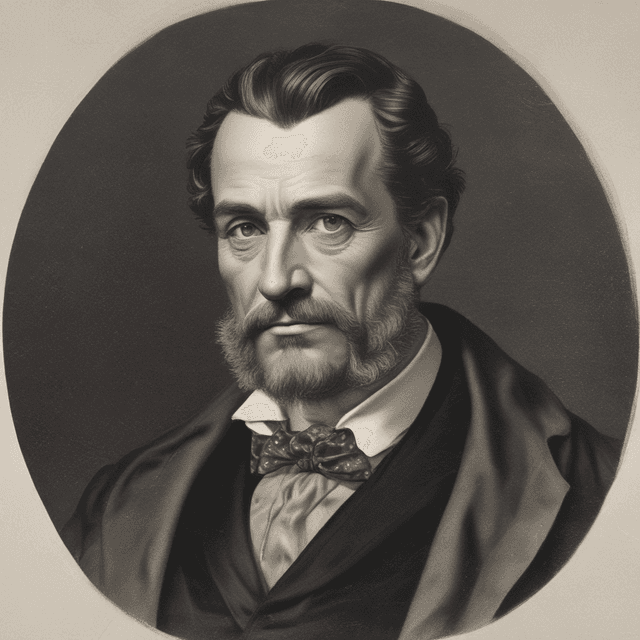
| Era | 19th century |
| Name | Germain Gagnier |
| Impact | Significant impact on political and social thought in France and Europe in the 1800s |
| Key ideas | Naturalism • Organic society • Traditional social structures and values |
| Known for | Critique of French Revolution and early industrialization, naturalism and organic society philosophy |
| Occupation | Philosopher |
| Nationality | French |
| Controversies | Controversial views |
Germain Gagnier (1804-1881) was a French philosopher and social theorist who rose to prominence in the mid-19th century as a prominent critic of the French Revolution, industrialization, and other forces of modernization sweeping across Europe. Gagnier developed an influential philosophical framework centered on the concepts of "naturalism" and the "organic society," which called for a restoration of traditional social structures and values.
Gagnier was born in the rural Normandy region of France and received his early education at a local Catholic seminary. He went on to study philosophy and theology at the University of Paris, where he was exposed to the works of Edmund Burke, Joseph de Maistre, and other influential conservative thinkers who had reacted against the French Revolution.
After completing his studies, Gagnier briefly considered entering the priesthood but instead chose to pursue an academic career, publishing his first major work, "The Corruption of Society," in 1834. In this text, he laid out his initial critiques of the French Revolution and the rising tide of industrialization transforming French culture and institutions.
At the core of Gagnier's philosophical outlook was a deep skepticism of the French Revolution and the Enlightenment values it championed. He viewed the Revolution's emphasis on individual liberty, rationalism, and secular governance as a dangerous disruption of France's organic social fabric.
In his writings, Gagnier argued that the Revolution had unleashed a wave of atomization, materialism, and moral decay within French society. He lamented the decline of traditional authorities like the Catholic Church and the nobility, seeing them as essential bulwarks against the excesses of the "tyranny of the majority" and the "dictatorship of the proletariat."
To counter the perceived ills of the modern world, Gagnier developed a philosophical framework he termed "naturalism." This system held that human societies, like natural ecosystems, function best when organized according to "organic" principles - with each individual and institution playing an interdependent role within a harmonious whole.
Gagnier believed that the traditional French social hierarchy, with its nobles, clergy, and peasants, represented such an organic society. He argued that the "artificial" political and economic structures imposed by the Revolution had disrupted this natural order, leading to social discord, moral decay, and environmental degradation.
Gagnier's vision of the "organic society" called for a restoration of traditional authorities, corporate social bodies, and communal values to counteract the individualism and materialism of modernity. He saw this as the only way to re-establish social cohesion, spiritual fulfillment, and humanity's rightful place within the natural world.
Though often dismissed in his time as a reactionary, Gagnier's naturalist philosophy had a significant impact on political and social thought in France and beyond. His ideas resonated with conservative and traditionalist thinkers who sought to challenge the dominance of liberal, socialist, and positivist ideologies.
Gagnier's writings influenced the development of organic conservatism, corporatism, and early environmentalism in Europe. His concept of the "organic society" was a key touchstone for Charles Maurras' Action Française movement in France, as well as Benito Mussolini's vision of the corporative state in Italy.
Gagnier's legacy remains a subject of intense debate. Supporters hail him as a prescient critic of industrialization's social and environmental costs, while detractors condemn his philosophy as a reactionary defense of feudal hierarchy. Even so, his writings continue to be studied and interpreted by scholars grappling with the tensions between tradition and modernity.
